

First UX Hire To PayScale Acquisition
As Payfactors' first and only designer, every pattern established became the product's design language, built from scratch and validated when PayScale acquired the platform.
HR & Compensation
Data Visualization
Zero-to-One Design
Compensation Analytics
Responsive

Quick
Price
Full UX scope across three core products: QuickPrice, Peer Association, and Job Ranges. All Axure prototyping, recorded monthly into product preview videos by the Head of Product. Every component pattern, interaction model, and design decision made solo as the only designer on the platform.
And every pattern had to do double duty: rigorous enough to survive a development handoff, flexible enough to scale across three products built at the same time. The prototypes were the spec, used in investor and customer demos before a line of code was written.
High-fidelity Axure prototypes carried the design language across QuickPrice, Peer Association, and Job Ranges, recorded monthly as the product preview the Head of Product demoed. Every component pattern and interaction model was a solo call, built to survive engineering handoff intact. After PayScale acquired Payfactors, QuickPrice kept running at scale across the combined platform.
Three compensation products, designed and shipped solo.
At an early-stage startup, design isn't just UX, it's product strategy made visible. The Axure prototypes weren't throwaway artifacts. They closed stakeholders, gave engineering a build reference, and after PayScale acquired Payfactors, QuickPrice continued running at scale across the combined platform.
QuickPrice

Demo
Compensation benchmarking data was regional, lagging, and impossible to trust.
HR compensation data updates once a year, lags behind market movement, and misses emerging job titles. Regional variation compounded the problem: the same role in Boston and St. Louis commands a very different rate. Generic benchmarks couldn't capture that delta.
A free, public tool that became a key reason Payfactors was acquired.
Launched as a fully public free tool, no login required. Intuitive salary benchmarking with regional calibration, fast enough to get an accurate number for any role in any market instantly. QuickPrice became a key selling point in Payfactors' acquisition by PayScale.
Peer Association

Demo
Compensation data was dirty, regional, and a year behind market reality.
Analysts needed to compare their compensation data against peer organizations, but no structured view existed. Without a clear way to see peer relationships, compensation decisions were made without competitive context.
A structured peer comparison view that scaled across large job libraries.
A two-column comparison view that made peer relationships immediately legible. Filtered out salary-associated jobs to reduce noise. Analysts could benchmark against peer organizations with confidence for the first time.
Job Ranges
Demo
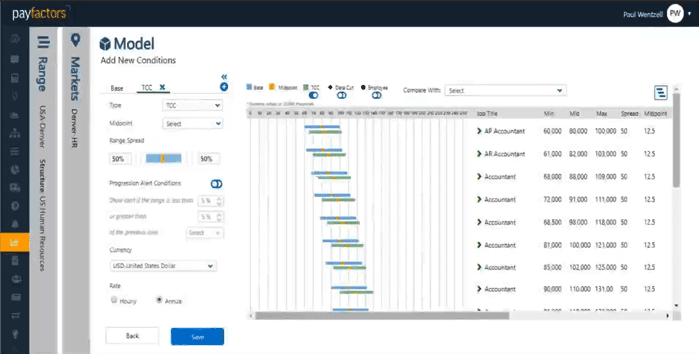
Analysts had no confident way to model or compare job ranges across peer groups.
Compensation analysts needed a flexible way to model job ranges across peer groups, but the interface lacked clarity and filtering logic, making it difficult to configure ranges with confidence or compare them across peer sets efficiently.
A single structured view for modeling and validating ranges across peer sets.
A single structured view for modeling and validating job ranges across peer sets. Two-column layout supported quick comparisons and model configuration. Unassociated jobs filtered out automatically, reducing manual effort and giving analysts a clean, auditable baseline to work from.
OUTCOMES
Three products shipped solo, one acquisition.
QuickPrice launched as a free public tool and became a selling point in the PayScale acquisition.
180+ enterprise clients onboarded within 30 days.
Three compensation products designed, prototyped, and handed to engineering by one designer.
A design language built from scratch that survived handoff and the acquisition intact.
What I'd do differently
A lightweight design system belonged in earlier. As the only designer, consistency held because one person stayed consistent, not because a system documented it, which was fine at startup scale. As the product and team grew, the missing component library created friction a real system would have prevented.