DASHBOARDS / FINRA Fin-Crimes Investigation Dashboard

FINRA — Six Tools Replaced, Twelve Teams Aligned

DXT

DXT

6 → 1

6 → 1

12

12

12

AWS

AWS

AWS

DIGITAL EXPERIENCE TRANSFORMATION

DIGITAL EXPERIENCE TRANSFORMATION

SILOED TOOLS

REPLACED

INVESTIGATION TEAMS

ALIGNED

CLOUD NATIVE

PLATFORM

KEY

DELIVERBLES

KEY DELIVERABLES

CLIENT

CLIENT

CLIENT

ROLE

ROLE

ROLE

TEAM

TEAM

TOOLS

TOOLS

FINRA

FINRA

FINRA

Senior

UX Designer

Senior

UX Designer

Senior UX

Designer

UX, Product,

Engineering

UX, Product,

Engineering

UX, Product,

Engineering

Figma, Jira,

Confluence

Figma, Jira,

Confluence

Figma, Jira,

Confluence

THE PROBLEM

FINRA's DXT initiative was stalling — not because investigators lacked tools, but because every team was using different ones, with no shared view of what was happening.

Six tools. Twelve teams. No shared view of active cases. Investigations were stalling not because investigators lacked capability — but because no single source of truth existed.

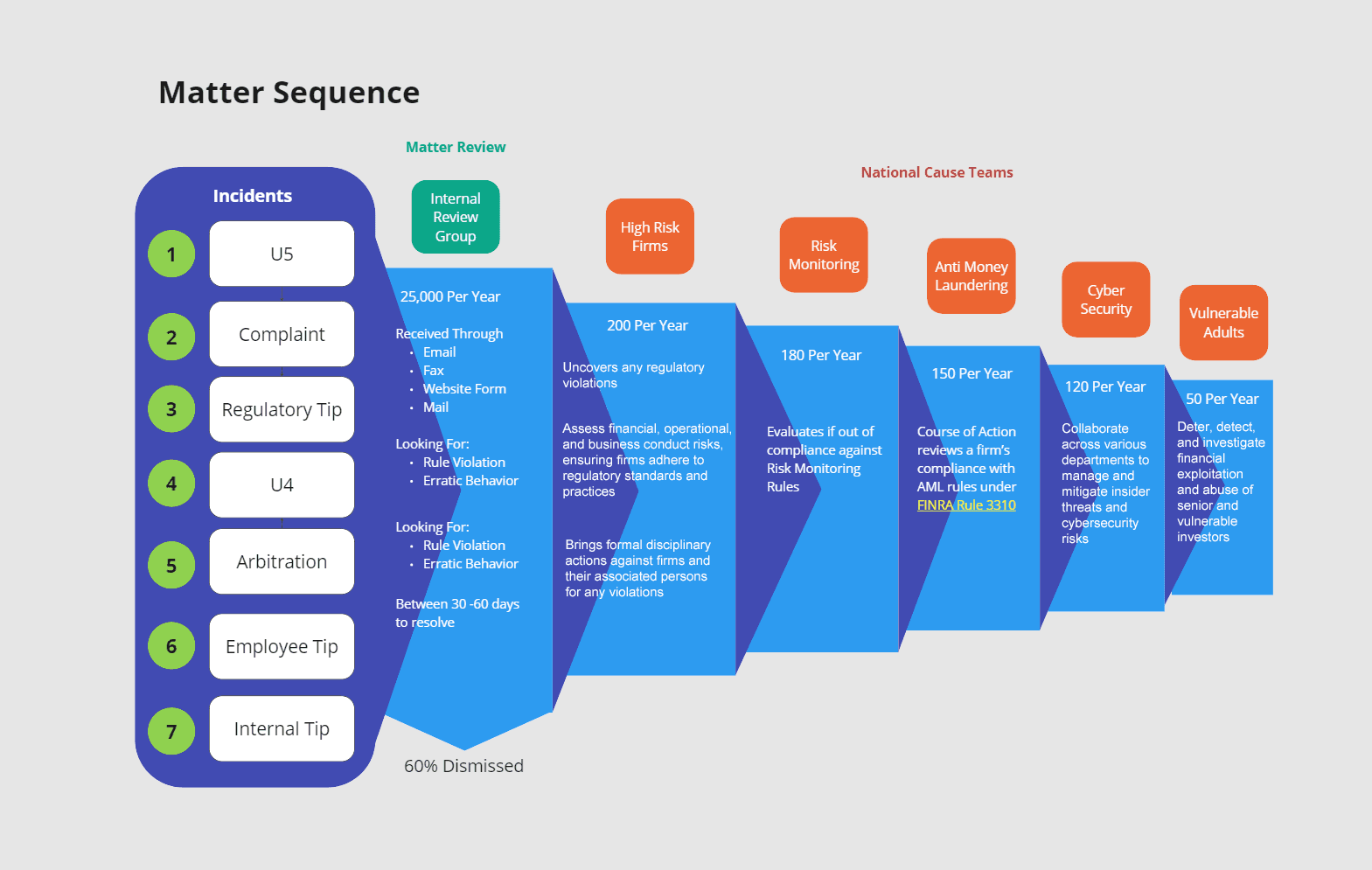
MATTER SEQUENCE — 7 INCIDENT TYPES ACROSS 6 NATIONAL CAUSE TEAMS, NO SHARED SOURCE OF TRUTH

THE CORE TENSION

The investigators didn't need faster tools. They needed one place where every team could see the same thing at the same time.

The DXT initiative was focused on speed — but the real blocker was visibility. Status lived in different systems depending on which team you asked. Once that root cause was clear, the design direction followed directly.

RESEARCH & DISCOVERY

What investigators actually told us.

Contextual inquiry across twelve investigation teams made the problem clear. Six siloed platforms, no shared case visibility, investigators manually copying case IDs between systems just to do their job. The DXT initiative was focused on speed. Research revealed the real blocker was structure.

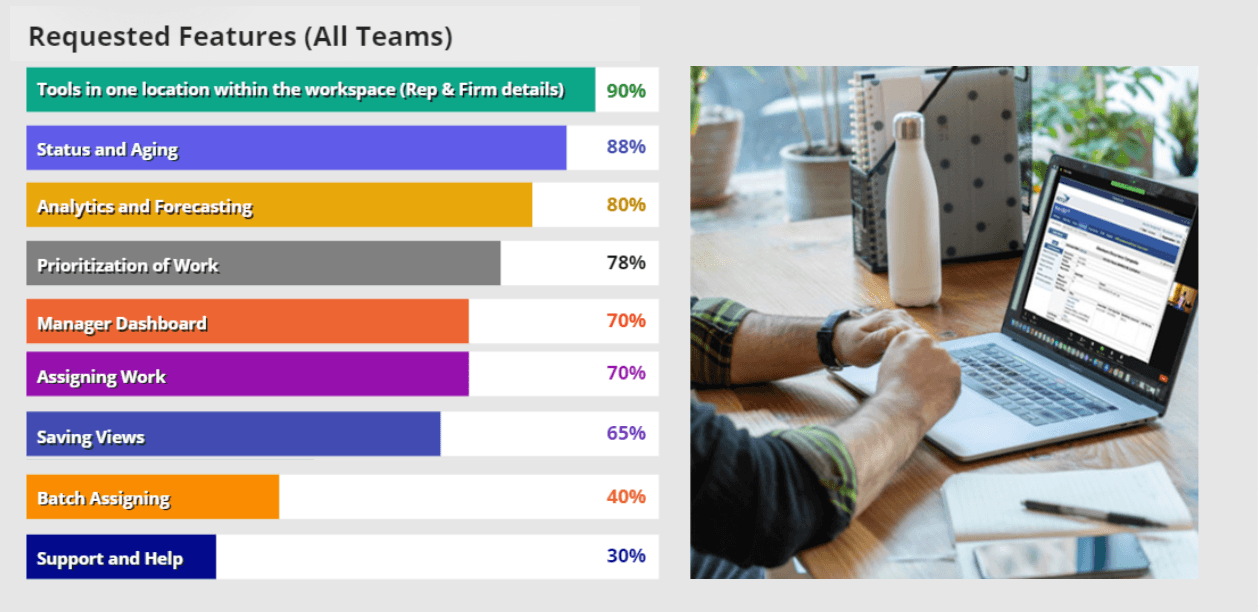
REQUESTED FEATURES — CROSS-TEAM STAKEHOLDER INQUIRY ACROSS 12 INVESTIGATION TEAMS

Stakeholder Inquiry

"I'm copying data between six different systems just to build one case."

Investigators were manually transferring information across disconnected platforms to assemble a single investigation record. Every transfer was a point of failure — and a delay in time-sensitive financial crimes work.

Stakeholder Inquiry

"We can't see what the other team is doing on the same case."

Twelve investigation teams were operating in isolation. No shared visibility meant duplicated effort, missed connections between related cases, and no way to coordinate across the organization on complex investigations.

Stakeholder Inquiry

"The tools aren't the problem. Nobody talks to each other."

Investigators had learned to work around their tools. The friction wasn't technical — it was structural. Each team had built its own workflow inside its own system, and none of them connected.

Stakeholder Inquiry

"We find out a case is connected to another investigation weeks later."

Without a shared platform, case connections surfaced too late — or not at all. Financial crimes investigations depend on pattern recognition across cases. Siloed systems made that structurally impossible.

KEY FINDING

The problem wasn't the tools. It was the silos.

The most important finding wasn't about features. It was about the organizational structure that technology had been built around — and reinforced.

Every team was using different tools — not because investigators didn't need to collaborate, but because the organization had never given them a shared place to do it.

Six siloed tools. Twelve teams. Zero shared visibility. The technology wasn't causing the silos — it was encoding them. This finding reframed the entire design brief. The solution wasn't better tools — it was one platform where every team could see the same investigation at the same time.

"The most important design decision wasn't what investigators needed. It was figuring out what was missing when they all looked at the same thing together."

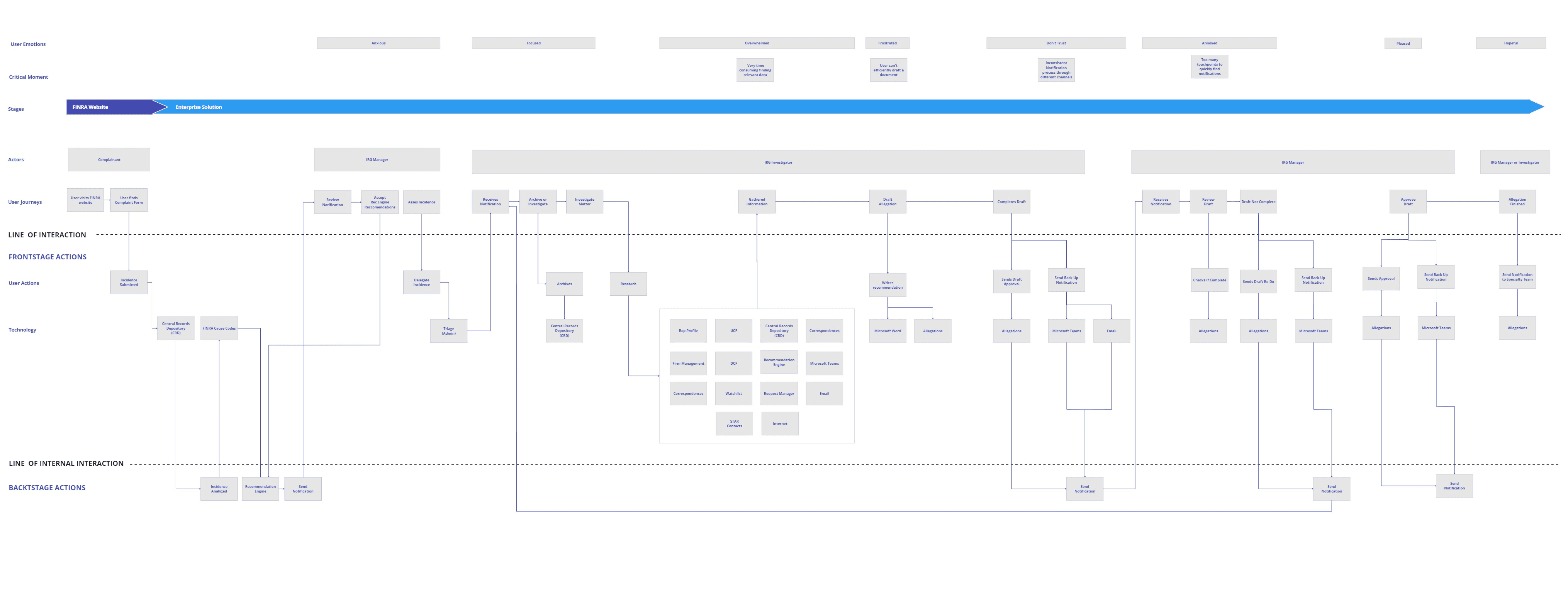
SERVICE BLUEPRINT — CROSS-TEAM INVESTIGATION FLOW ACROSS ACTORS, SYSTEMS, AND TOUCHPOINTS

CORE TENSION

Organizational control vs investigator autonomy — two needs the design couldn't sacrifice.

Leadership needed oversight across twelve teams. Investigators needed autonomy to work their cases without management overhead slowing them down. The design had to hold both simultaneously.

STAKEHOLDERS WANTED

Shared visibility across all teams

  • Audit trail on every action

  • Cross-team case connections

  • Consistent process governance

INVESTIGATORS

NEEDED

INVESTIGATORS NEEDED

Fast access to their own cases

Fast access to their own cases

  • No bureaucratic overhead

  • Customizable workspace per role

  • Batch actions at scale

  • Priority flagging they control

DESIGN RESOLVED

Modular by design — role-based views

Modular by design — role-based views

  • Manager view active case dashboard

  • Every priority linked to investigator

  • Angular/.NET widget governance

  • Batch selection at investigation scale

The Resolution

Managers see the full picture across all teams. Investigators own their workspace and their cases. The platform surfaces shared context without removing individual control.

DESIGN DECISIONS

Every decision traced back to a finding.

Five distinct design choices — each one a direct response to something we heard from the investigation teams.

Five distinct design choices — each one a direct response to something we heard from the investigation teams.

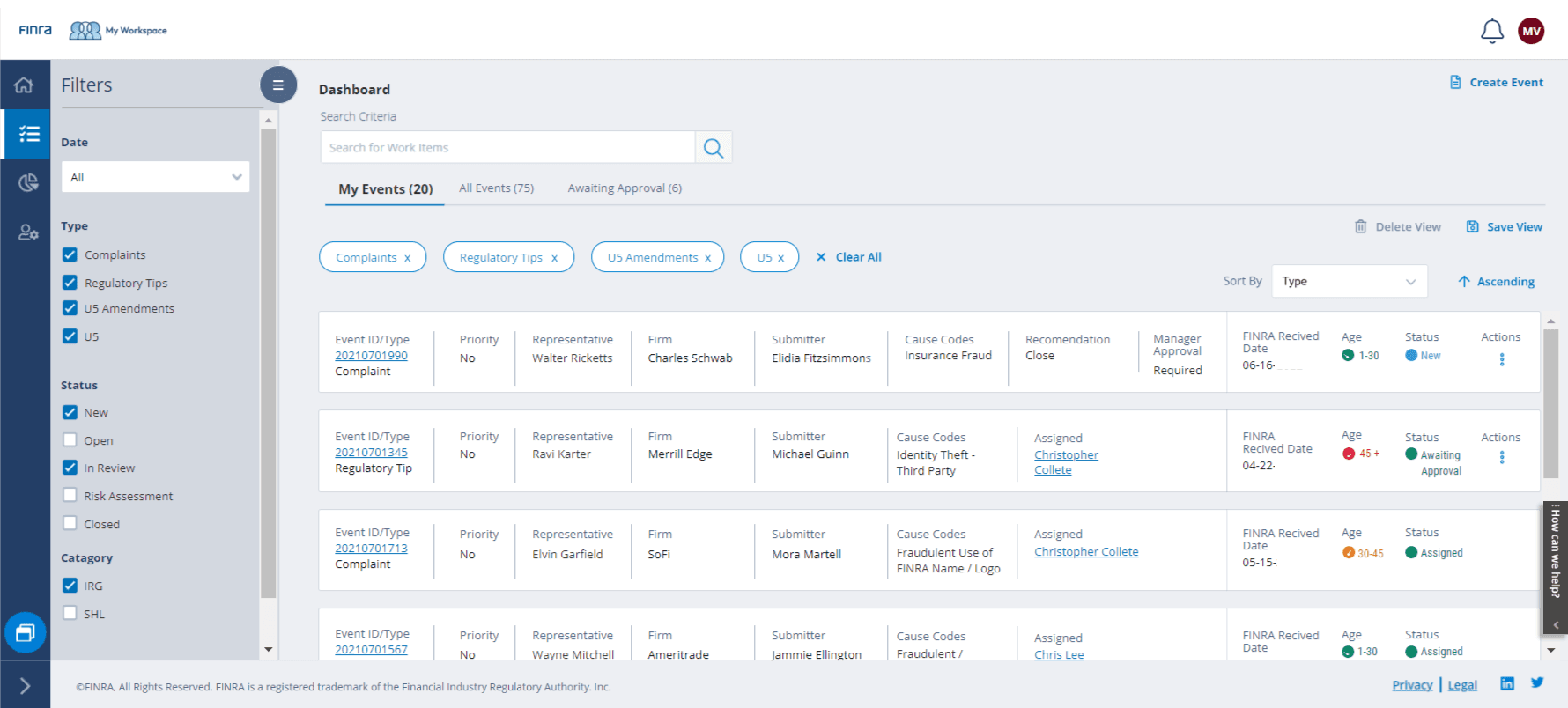
  1. Unified investigation workspace — replacing six siloed tools with one shared platform.

MY WORKSPACE DASHBOARD — ALL MATTER TYPES, TEAMS, AND CASE STATUS IN A SINGLE VIEW

FINDING

FINDING

Investigators were manually transferring data across six disconnected systems to build a single case record. No shared view existed across the twelve investigation teams.

Investigators were manually transferring data across six disconnected systems to build a single case record. No shared view existed across the twelve investigation teams.

INSIGHT

INSIGHT

The silos weren't accidental — they were encoded in the technology. Every tool had been chosen by a team for a team. The fix had to be organizational, not just technical.

DESIGN

DESIGN

DESIGN

DXT — a single Angular/.NET modular platform replacing all six tools. Every team, every case, every workflow in one shared environment. Built on AWS cloud-native architecture for scale.

DXT — a single Angular/.NET modular platform replacing all six tools. Every team, every case, every workflow in one shared environment. Built on AWS cloud-native architecture for scale.

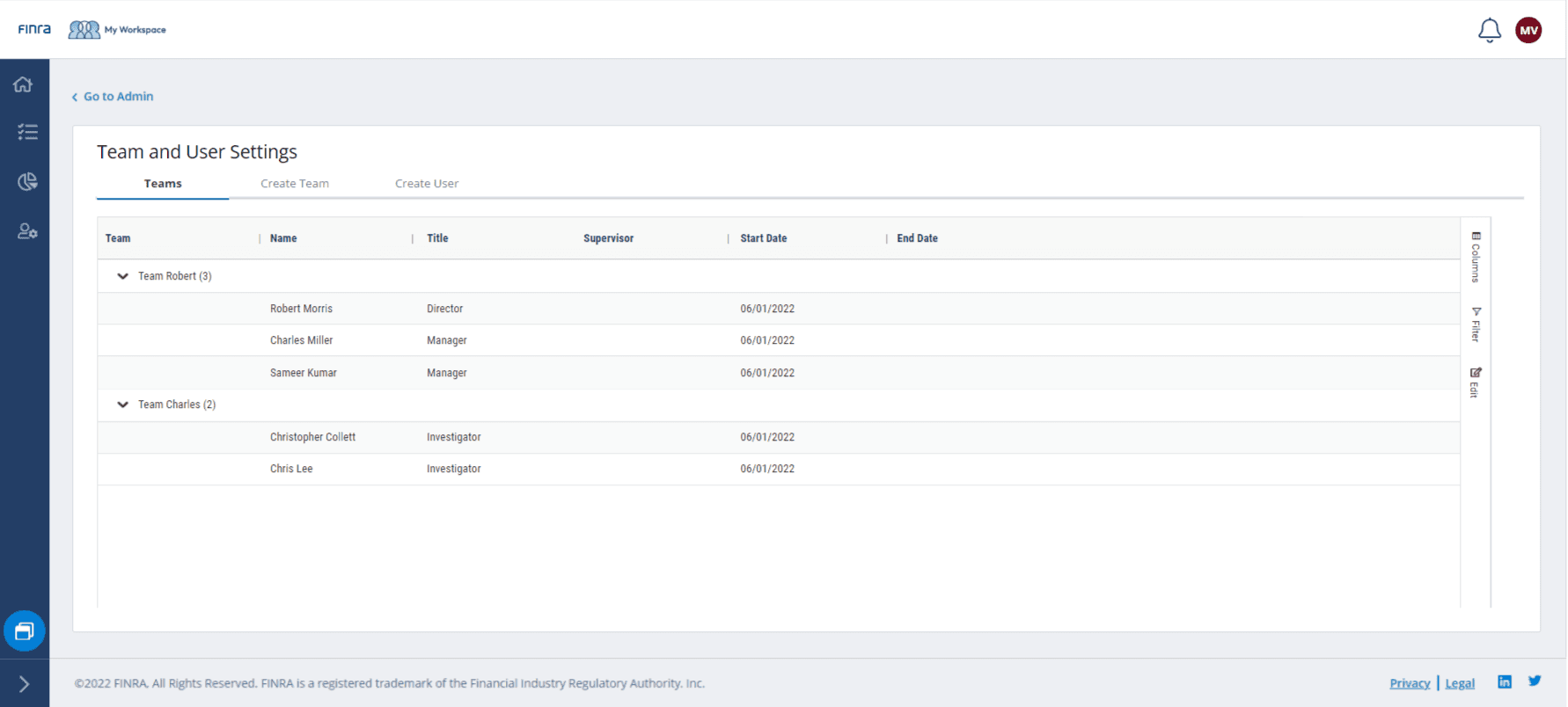
  1. Modular by design — customizable to the investigator, governed by the organization.

MODULAR WORKSPACE VIEW — INVESTIGATOR AND MANAGER ROLES SURFACED THROUGH CONFIGURABLE DASHBOARD CONTROLS

FINDING

FINDING

Twelve teams had built twelve workflows. A single rigid interface would have replaced one problem with another — forcing investigators into a process that didn't match how they actually worked.

Twelve teams had built twelve workflows. A single rigid interface would have replaced one problem with another — forcing investigators into a process that didn't match how they actually worked.

INSIGHT

INSIGHT

The platform needed to be flexible at the investigator level and governed at the organization level. Role-based modularity was the only architecture that could serve both simultaneously.

DESIGN

DESIGN

DESIGN

Angular/.NET modular widget system — investigators customize their workspace view. Organization-level governance controls what data surfaces where. Validated through fast prototype sessions before any production build.

Angular/.NET modular widget system — investigators customize their workspace view. Organization-level governance controls what data surfaces where. Validated through fast prototype sessions before any production build.

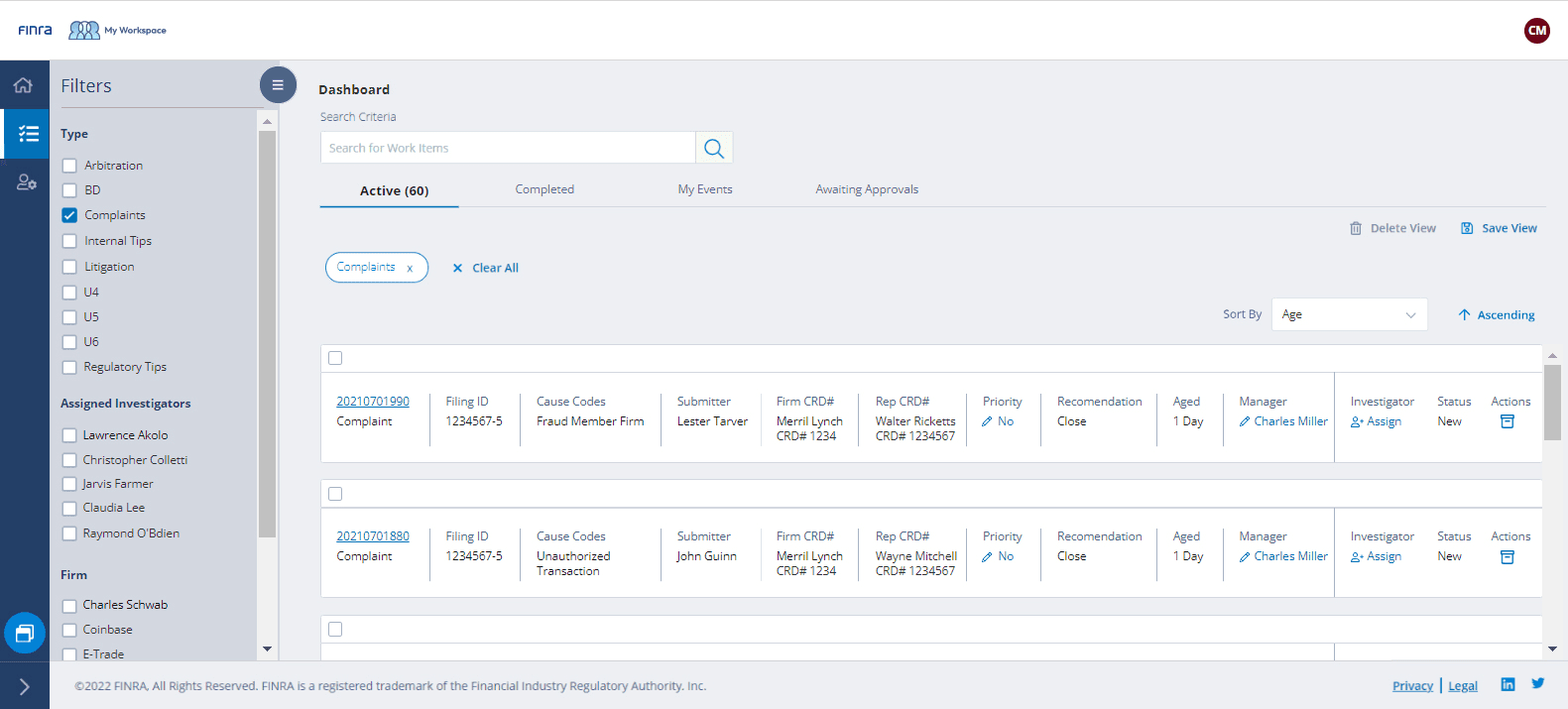
  1. Lo-fi prototype shared directly with investigators the first time this feedback process had ever been run at FINRA.

EARLY NAVIGATION WIREFRAME — SELF-GUIDED PROTOTYPE WITH FILTER PANEL AND ASSIGNMENT FLOW

FINDING

FINDING

Investigators had never reviewed a prototype and given direct feedback before. Getting real, unfiltered input on the workflow design required introducing a new process — not just a new interface.

Investigators had never reviewed a prototype and given direct feedback before. Getting real, unfiltered input on the workflow design required introducing a new process — not just a new interface.

INSIGHT

INSIGHT

If investigators had to be guided through the prototype, the feedback would be about the guidance not the design. The prototype had to work without a facilitator in the room.

DESIGN

DESIGN

DESIGN

Intentionally lo-fi. Pink indicators marked functioning interactions so investigators could explore independently and give unfiltered feedback on their own time. First-ever self-guided validation session at FINRA. What came back directly influenced the final design.

Intentionally lo-fi. Pink indicators marked functioning interactions so investigators could explore independently and give unfiltered feedback on their own time. First-ever self-guided validation session at FINRA. What came back directly influenced the final design.

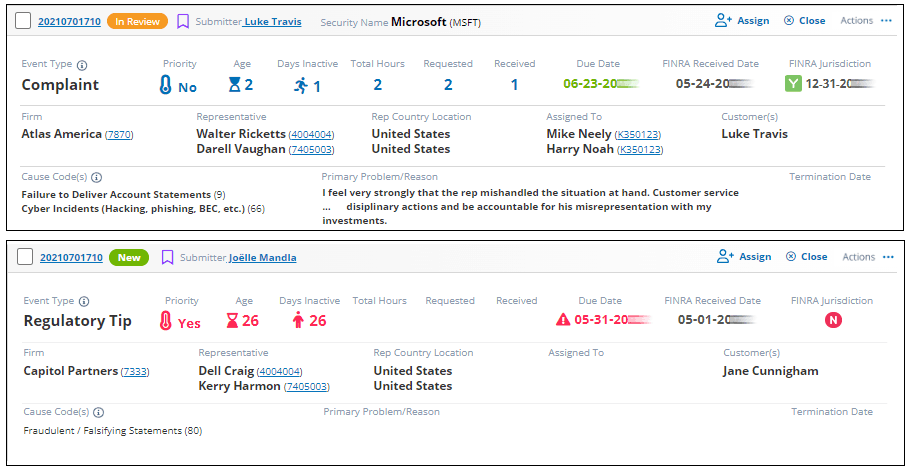
  1. Every priority linked to an investigator — accountability built into the data model.

DESIGNED MATTER CARDS — PRIORITY, INVESTIGATOR, AND CASE STATUS SURFACED AT A GLANCE

FINDING

FINDING

Without shared visibility, case priorities were invisible across teams. Managers had no way to see workload distribution. Investigators had no way to flag urgency that others would see.

Without shared visibility, case priorities were invisible across teams. Managers had no way to see workload distribution. Investigators had no way to flag urgency that others would see.

INSIGHT

INSIGHT

Priority is only meaningful if it's visible to the right people at the right level. Linking every priority to a named investigator made accountability explicit without requiring manual reporting.

DESIGN

DESIGN

DESIGN

Every case priority surfaces with the assigned investigator. Manager view shows active cases, workload, and priority distribution across all twelve teams in real time — no separate reporting layer required.

Every case priority surfaces with the assigned investigator. Manager view shows active cases, workload, and priority distribution across all twelve teams in real time — no separate reporting layer required.

  1. Matter sequence and service blueprint — mapping the full investigation flow before designing any screen.

END-TO-END INVESTIGATION FLOW — FULL SERVICE BLUEPRINT MAPPED ACROSS ALL TWELVE TEAMS BEFORE UI WORK BEGAN

FINDING

FINDING

No one had ever mapped the end-to-end investigation process across all twelve teams. Each team knew its own workflow. Nobody had the full picture. The platform couldn't be designed without it.

No one had ever mapped the end-to-end investigation process across all twelve teams. Each team knew its own workflow. Nobody had the full picture. The platform couldn't be designed without it.

INSIGHT

INSIGHT

A service blueprint wasn't just a research artifact — it was the foundation the entire design had to be built on. Without it, any screen designed would be optimizing one team's workflow at the expense of another's.

DESIGN

DESIGN

DESIGN

Matter sequence map and end-to-end service blueprint delivered before any UI work. The full investigation flow — from complaint intake to resolution — documented across all teams and used as the design foundation throughout the project.

Matter sequence map and end-to-end service blueprint delivered before any UI work. The full investigation flow — from complaint intake to resolution — documented across all teams and used as the design foundation throughout the project.

WHAT USER SAID

Slowness — investigations taking too long to resolve

Every team pointed to the same symptom: things moved too slowly. Escalations were delayed, status was unclear, and critical signals weren't reaching the right people. The instinct was to optimize each team's individual workflow.

WHAT RESEARCH REVEALED

Silos — each team operating in its own disconnected system

The actual cause was structural: different teams used different tools, spoke different status languages, and had no shared view of case state. Optimizing individual workflows would have left the coordination problem completely unsolved.

MY ROLE

Led UX design for the Financial Crimes Investigation Dashboard — contextual research through widget architecture and final prototype validation.

WHAT I OWNED

Full UX scope — contextual inquiry, workflow mapping, investigative flow architecture, widget component design, interaction fidelity prototyping, fast validation testing, and visual clarity refinement.

HOW I WORKED

Designed for FINRA's Gateway platform on AWS — a widget-centric dashboard with an Angular frontend and .NET microservices backend. Components were built as modular, interchangeable widgets consumable across the full platform.

THE CONSTRAINT

Contextual inquiry revealed what the DXT initiative hadn't named: teams were working in siloed tools with no shared source of truth for case status. The unified dashboard wasn't the starting assumption — it was where the evidence pointed.

PROCESS

Five phases — from contextual inquiry and workflow mapping to interaction fidelity and fast validation.

Contextual inquiry revealed the real problem: every team was tracking the same cases in different systems with no shared truth. That single finding reframed the entire design direction.

1

1

Discovery & Research Delivery

Contextual inquiry across investigative teams revealed the real blocker: no shared source of truth, not slow workflows.

2

2

Building the Unified Mental Model

Mapped the full investigative lifecycle — tracing case intake to resolution and surfacing where investigators needed consolidated context most urgently.

3

3

Platform Architecture & Solutions

Architected a modular widget system in Angular/.NET — purpose-built so investigative data from every team could surface into a single governed workspace.

4

Modular Mind Mechanics

Built widget patterns flexible enough for every team's data model — without requiring a custom solution for each one.

5

Implementation & Governance

Shipped AWS-ready specs and Angular/.NET component governance — adopted by FINRA's Gateway platform and handed off with zero ambiguity.

WIDGET - BASED ARCHITECTURE

Modular by design customizable by investigator

Built on FINRA Gateway's widget framework — each investigative function (case summary, alert feed, data cross-reference, timeline) existed as an independent, interchangeable component. Investigators could configure their workspace without losing system coherence.

CROSS-TEAM ALIGNMENT

Every priority traceable to investigator evidence

The contextual inquiry data directly drove feature prioritization, widget hierarchy, and information density decisions. Nothing in the final design was arbitrary — every choice mapped back to a documented investigator need or workflow constraint.

"The most important design decision wasn't visual — it was defining which investigative functions needed to live together in the same view, and which ones could stay a click away."

OUTCOMES

A unified investigative workspace — six tools replaced, twelve teams aligned, one shared source of truth.

Consolidated 6+ investigative tools into a single, configurable workspace — eliminating the context switching that slowed investigator decision-making.

Widget-based architecture adopted across FINRA Gateway — modular components that investigators could configure around their specific workflow needs.

Faster alert triage and case review — structured risk indicators and progressive disclosure replaced manual cross-refere

Single shared source of truth — for the first time Every investigative team seeing the same case status in the same place, ending the coordination failures that slowed resolution.

PROJECT GALLERY

From investigation flow mapping to unified case workspace

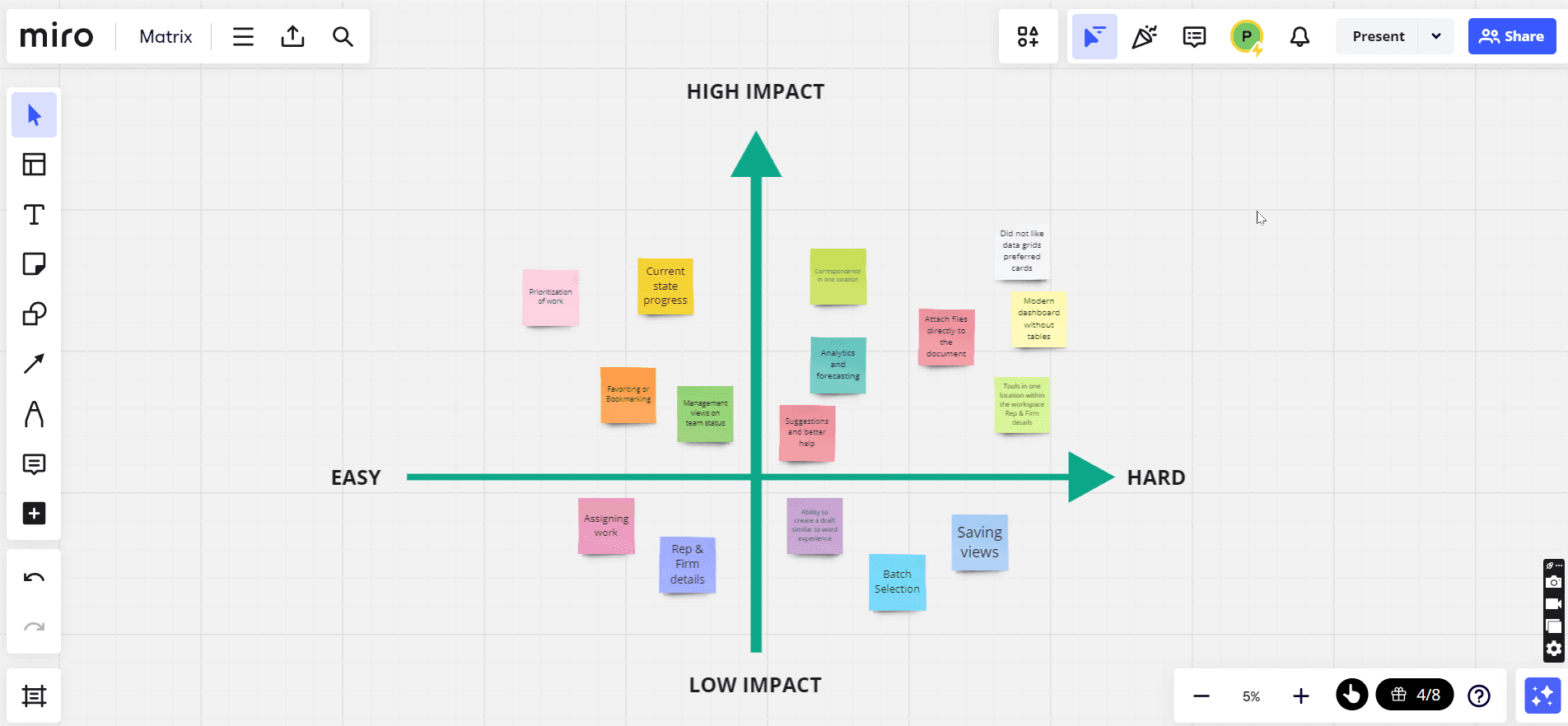
Impact/Effort Matrix — Feature Prioritization

Complaint Investigation Process Flow

Disposition — U5 Investigation Process Flow

Card Hierarchy 01

Card Hierarchy 02

Card Hierarchy 03

Complaint

Admin View

U5 Disposition

Batch Selection — Multi-Case Assignment Workflow

Final Dashboard — Investigator

Manager View — Active Cases & Team Assignment

What I'd do differently

Start widget governance conversations with engineering earlier. The modular architecture worked well, but some widget interaction patterns particularly cross-widget data sharing and state persistence weren't fully defined until mid-build. A joint design-engineering session on widget communication contracts at the start of the project would have prevented the rework that came later. When the component architecture is this central to the product, the technical model and the design model need to be designed together from day one.