DASHBOARDS / GenStar Insurance Underwriting Dashboard

General Star Underwriting Workspace
From Five Disconnected Tools To One

BEFORE

Legacy loss rating output, pre-GENESIS G2

AFTER

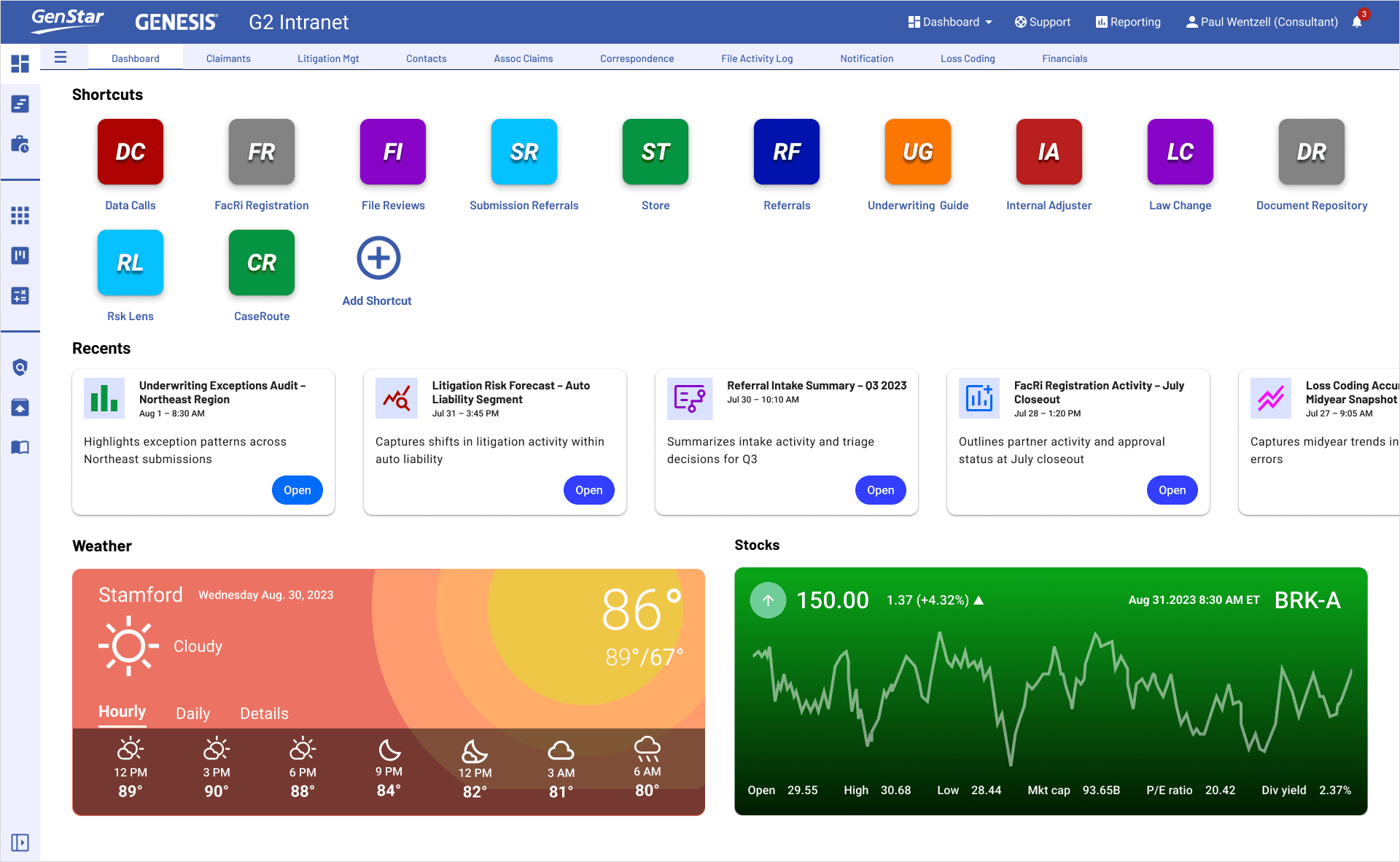
The unified GENESIS G2 workspace: shortcuts, recents, and a submissions surface in one place.

Lead UX for the role-based dashboard on GENESIS G2 that replaced five disconnected tools, rebuilding how underwriters reach, read, and act on risk.

The redesign brought the underwriting decision onto one role-based workspace, organized around the moment a risk gets priced and bound. The workspace unified a standardized Power BI activity dashboard, a dense AG Grid triage view, and live weather and market signal on one component system that holds up across React and Angular. Underwriters moved from assembling a picture across five screens to reading and acting on risk in one place.

Client / General Star Insurance

Client / General Star Insurance

Industry / Insurance

Category / Insurance

Team / UX, Product, Engineering

Team / UX, Product, Engineering

Platform / Desktop

Platform / Desktop

Role / Lead UX Designer

Role / Lead UX Designer

Tools / Figma, Miro

Tools / Figma

Timeline / 6 months

Timeline / 6 months

Framework / React and Angular on .NET and Azure

Framework / .NET & Azure

Aviation Maintenance

Workflow Design

Field Service

Mobile-Android

Data Visualization

THE PROBLEM & BUSINESS CONTEXT

A decision-latency problem, not a UI cleanup

The cost of five disconnected tools was not only friction. It was decision latency, and in underwriting, decision latency is a business problem: the longer it takes to read a risk and act, the fewer submissions move through, and the more inconsistent the calls that do. That was the framing I brought to the product owner and engineering lead before any design began.

Slow, fragmented decisions throttled policy throughput and pressured loss ratios. The fix had to protect the volume of policies underwriters could move and the quality of the decisions behind them, a throughput-and-loss-ratio problem, not a UI cleanup.

CONSTRAINTS I NAVIGATED

Research in a single sprint

I had one sprint to run discovery: stakeholder interviews across underwriting leads, senior underwriters, claims reviewers, and managers, plus a comparative audit. The compressed timeline meant prioritizing the interviews that would most directly shape the decision model, and treating the audit as evidence to justify direction rather than open-ended exploration.

Cross-framework parity

GENESIS G2 ran React and Angular modules with AG Grid for data-dense views. Every component had to hold up across both frameworks with no custom patches, which meant designing to a tokenized Material system rather than one-off screens.

Build on the existing stack

The work sat on GENESIS G2's .NET and Azure platform. The design had to fit the technical reality already in place, not assume a rebuild.

ROLE & PROCESS

Built for data entry, used for decisions

The decisive insight: the tools were built for data entry, but underwriters were using them for decisions. The workspace had to be built from the underwriting decision outward, not adapted from a data-entry model inward.

Ownership ran across the full UX: stakeholder interviews across four underwriting roles, a comparative audit to ground the visual direction, the role-based information architecture, the dashboard and reporting design, and handoff specs across React, Angular, and AG Grid. The work mapped how underwriters actually read a risk, then organized the workspace and its data flows around that decision.

Underwriting Lead

"I have no real-time data when I need to make a confident decision."

Underwriters made risk decisions off end-of-day summaries and static exports. The signal data they needed (market conditions, submission status, prior claims) lived in separate tools with no live connection to the workspace.

Senior Underwriter

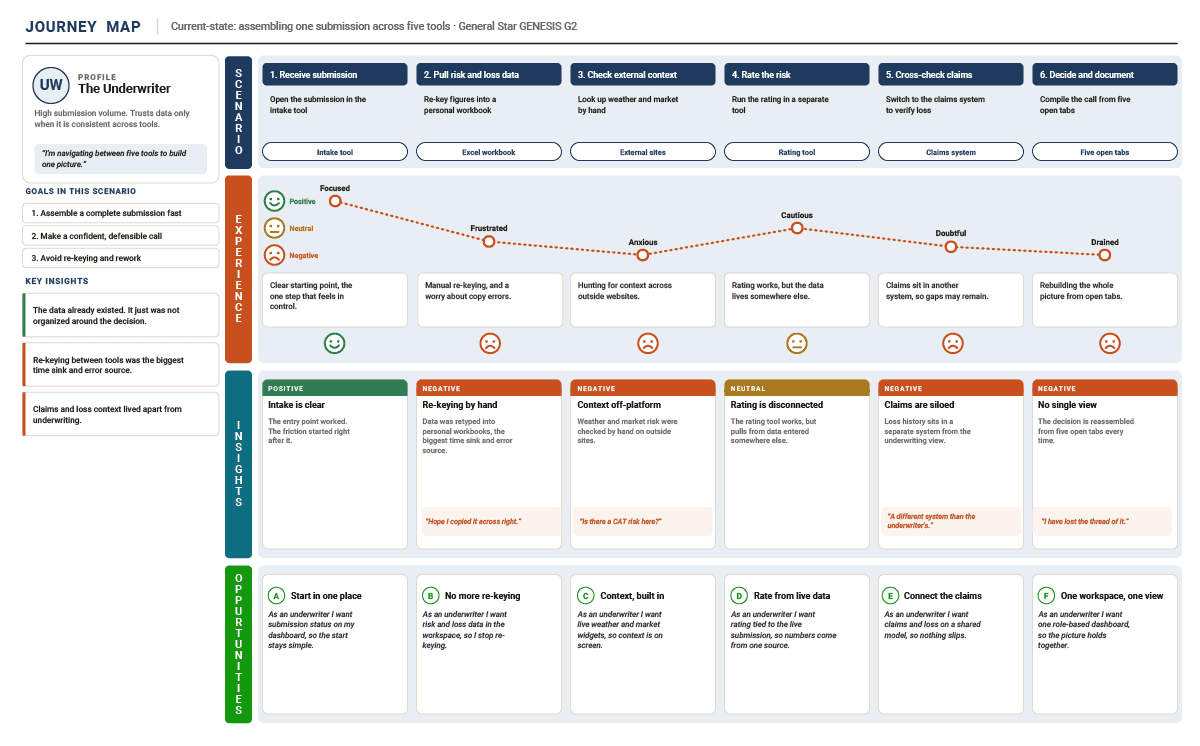
"I'm navigating between five tools to build one picture."

No single workspace held the underwriting view. Building one picture meant moving between external lookups, shared spreadsheets, and legacy tools, none of which used the same hierarchy or status model.

Underwriting Manager · Excess Casualty

"I spend more time finding information than evaluating it."

The navigation was where the work happened. Every screen change meant rebuilding the picture before the underwriter could move.

Each lookup pulled an underwriter out of one screen and into another, rebuilding context on the way back. The system was good at storing data. Making decisions with it was the underwriter’s job.

Current-state journey: the decision across five tools, with the breakpoints that set the redesign priorities.

THE FINAL SOLUTION

Five tools became one role-based workspace: a standardized Power BI reporting surface, a dense triage grid, and live decision signal, all on one component system spanning React and Angular, and responsive from laptop to large 4K displays.

KEY FEATURE 1

The Power BI dashboard, redesigned for clarity

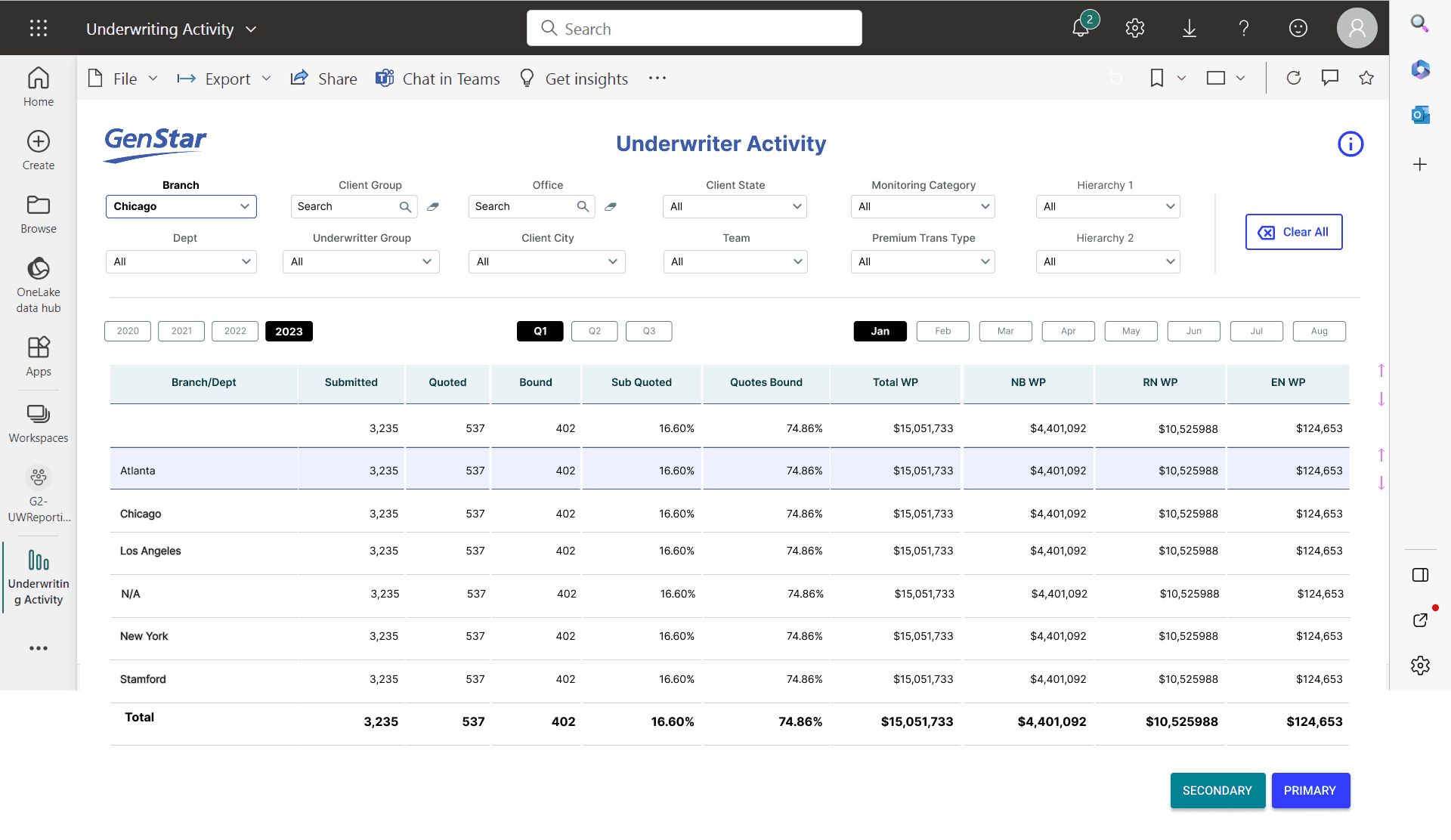
Redesigned the Underwriter Activity Power BI report against a tokenized design system, standardizing the filter bar, chips, table, header, and buttons for visual clarity and consistent interaction patterns. Both treatments went to stakeholders. They chose Treatment A, the white filter header, to keep the filter bar quiet so the data grid leads, and it carried into the build.

Treatment A White Filter Header

Treatment B Navy Filter Header

KEY FEATURE 2

AG Grid as the triage surface

Turned the dense submission grid into a decision tool: predictable sort, filter, and row interactions, status badges color-coded to underwriting state, and named insured visible at every row. Three rounds of iteration calibrated badge design, density, and column priority against real submission volumes.

Treatment A White Filter Header

KEY FEATURE 3

Live weather and market signal, on the decision screen

Built weather and market widgets into the workspace as native components so underwriters stopped leaving mid-decision to check property and exposure risk. External context became part of the decision surface, not a separate lookup.

17 weather states covered seasonal and time-of-day variation; 9 stock variants covered display contexts. Live data via NOAA and market feeds, no iframes and no external link-outs.

Role-based access and responsive range

Each role saw the access and surfaces its job required, mapped explicitly across the workspace. The whole system was built responsive from laptop to large 4K monitors, the range underwriters actually work on.

ROLESubmissionsRating EngineAG Grid TriageClaims & LossReporting & Power BIPortfolio ActivityAdmin & Config
Underwriting Lead
Dana K.
FullFullFullViewViewView
Senior Underwriter
Marcus R.
EditFullFullViewView
Claims Reviewer
Priya S.
ViewViewFullView
Underwriting Manager
Ellen H.
ViewViewViewViewFullFullEdit
ACCESSFullEditViewno access
IN GENESIS G2
The Underwriter Activity dashboard, with branch, team, and hierarchy filters, plus recents and a standardized reporting surface, gave oversight in one place rather than across five tools.

OUTCOMES

A unified workspace the platform adopted

25% / Faster Underwriting Decisions

BEFORE

Risk read across five tools, with re-keying between each

AFTER

One workspace organized around the decision

0 / Custom Workarounds

BEFORE

Five disconnected tools, manual re-keying

AFTER

One role-based workspace, zero custom workarounds

5→1 / Tools Consolidated

BEFORE

Five disconnected tools

AFTER

One role-based workspace

4→1 / Frameworks Unified

BEFORE

Separate React and Angular surfaces, no shared system

AFTER

One tokenized component system across both

DELIVERABLES

Wireframes, Component System, and Final Deliverables

Wireframes 1

Wireframes 2

Wireframes 3

Wireframes 4

Component System 1

Component System 2

Component System 3

Component System 4

Weather Widgets

Dashboard

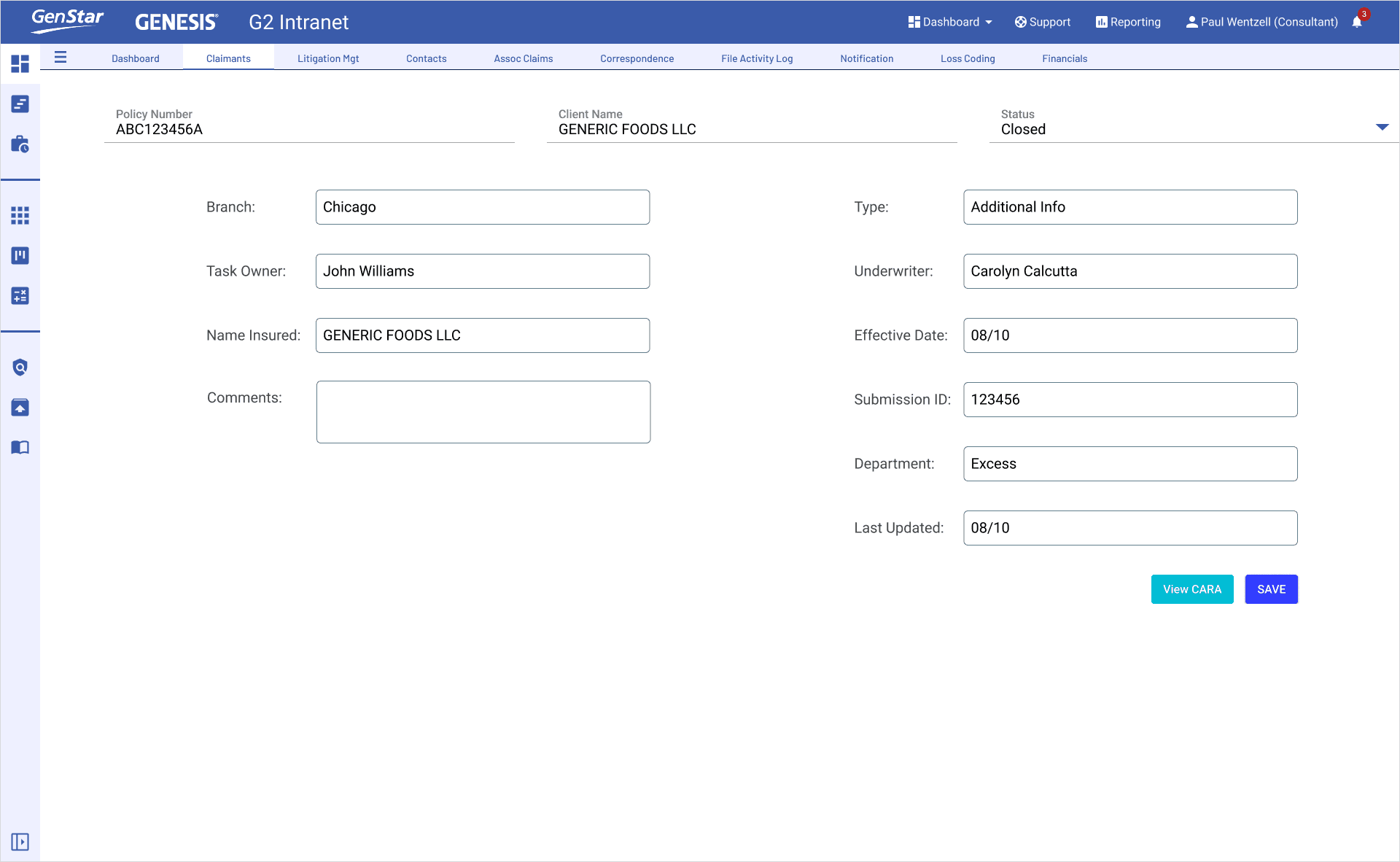
Claimant Form

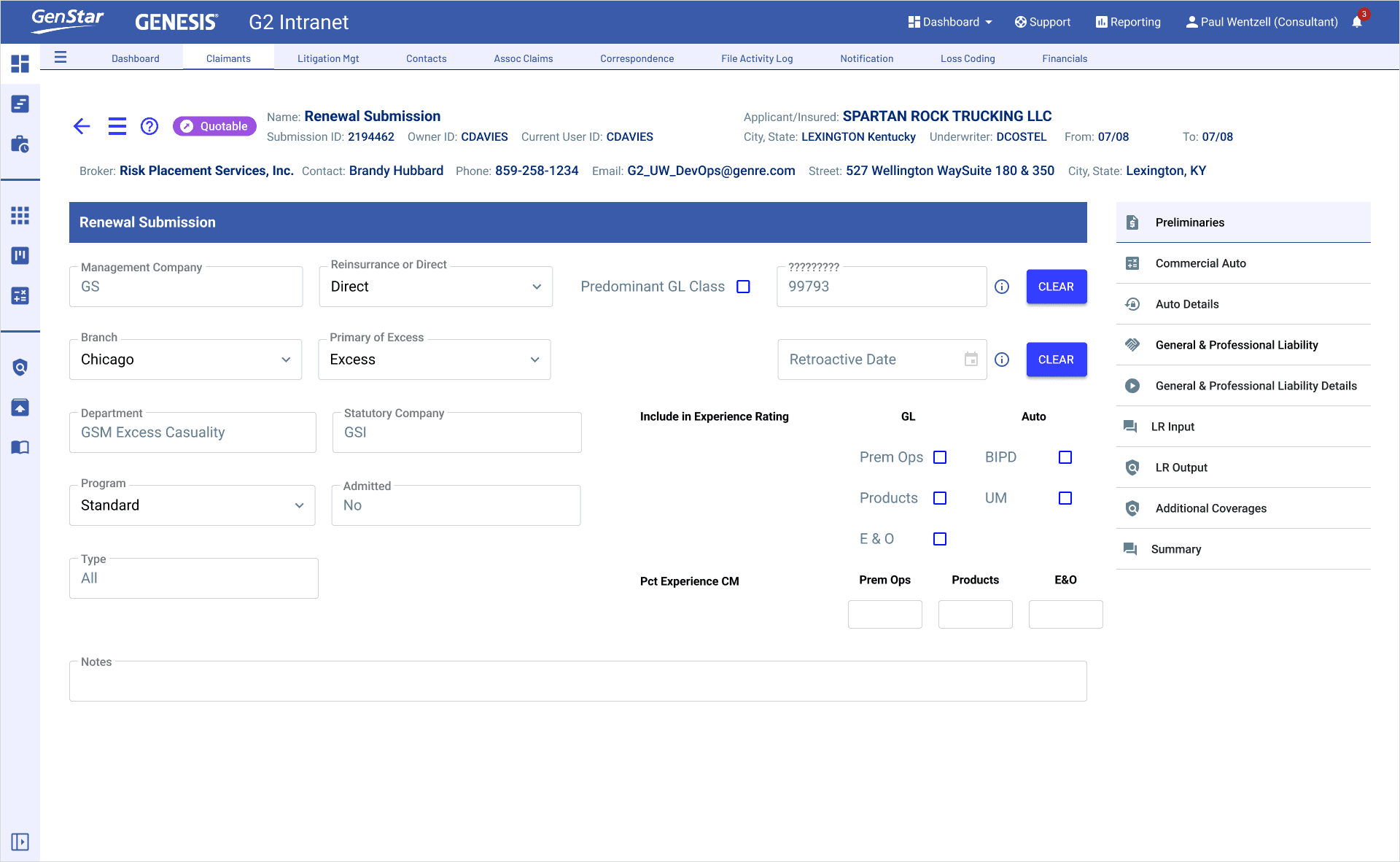
Renewal Form
What I'd do differently

Bring underwriting leads into component review. They were in discovery, but the spec reviews where component behavior actually got decided ran engineering-only. The density and disclosure calls that came back for revision were the ones an underwriter would have settled in one pass, because they know how the data reads under pressure.

COPYRIGHT © 2026 | Paul Wentzell UX